What Specifications Should You Check Before Ordering a Replacement Spacer Coupling?
- By: Expert Team
- October 9, 2026
Are you replacing a worn spacer coupling between an industrial pump and motor? Incorrect dimensions, torque ratings, or mounting arrangements can cause installation delays, vibration, and premature equipment failure.
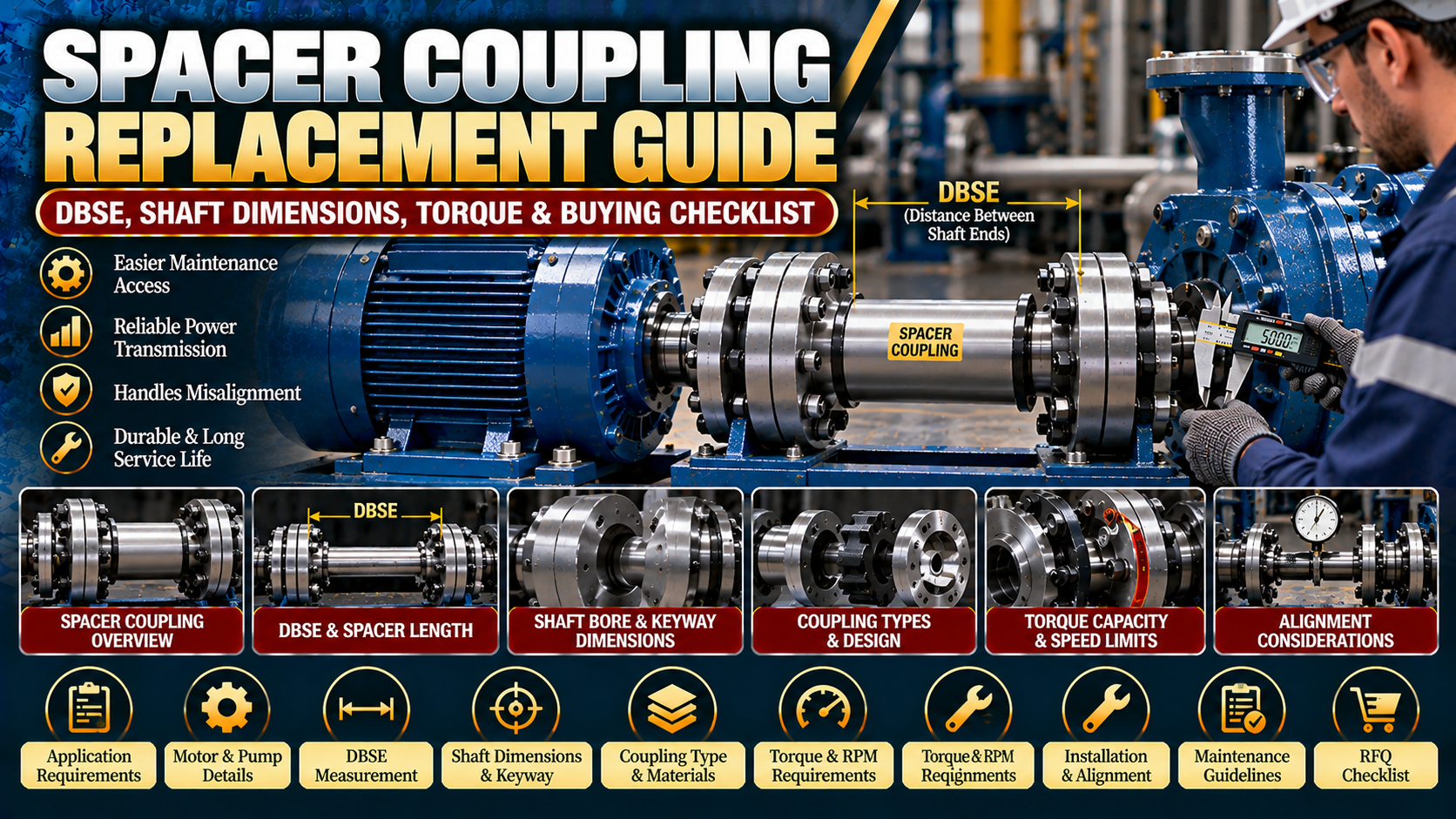
The essential spacer coupling replacement specifications include distance between shaft ends (DBSE), shaft diameters, hub bores, keyways, torque capacity, operating speed, coupling design, and alignment requirements.
A complete specification helps buyers source compatible replacement components without unnecessary modifications.
JobWurx Industrial Ventures supplies industrial couplings and power transmission components for machinery applications.
What Is an Industrial Spacer Coupling?
An industrial spacer coupling connects two rotating shafts through an intermediate spacer section while transmitting torque between the driving and driven equipment.
A typical arrangement includes:
-
Driving-side hub.
-
Driven-side hub.
-
Removable spacer section.
-
Fasteners and connecting elements.
-
Flexible components, where applicable.
Common applications include centrifugal pumps, motor drives, chemical processing equipment, and industrial rotating machinery.
Explore Spacer Couplings for product information.
Why Are Spacer Couplings Used Between Pumps and Motors?
Spacer couplings provide shaft separation and can improve maintenance accessibility for compatible pump arrangements.
In back-pull-out centrifugal pumps, removing the coupling spacer may allow maintenance of the pump's rotating assembly without moving the motor or disconnecting the main process piping.
Advantages can include easier access to mechanical seals, bearings, and other internal components.
The actual maintenance clearance must follow the pump manufacturer's requirements.
What Is DBSE in a Spacer Coupling?
DBSE means Distance Between Shaft Ends, the axial separation between the connected equipment shafts.
It is one of the most important replacement measurements.
Before ordering, verify:
-
Existing DBSE.
-
Required spacer removal clearance.
-
Hub mounting positions.
-
Coupling overall dimensions.
-
Equipment manufacturer's drawing.
Do not assume the removable spacer length is always identical to the DBSE.
How Do You Measure Shaft Bore and Keyway Dimensions?
Measure each shaft and confirm the corresponding hub bore, keyway, and mounting requirements using approved drawings and suitable instruments.
Record:
-
Motor shaft diameter.
-
Pump shaft diameter.
-
Hub bore sizes.
-
Keyway width and depth.
-
Hub length.
-
Shaft-end configuration.
-
Locking arrangement.
The driving and driven shafts may have different diameters.
For replacement applications, verify the original fit and tolerance specifications.
How Do You Calculate the Required Coupling Torque?
Coupling torque selection should account for transmitted power, operating speed, starting loads, and the manufacturer's applicable service factors.
For a preliminary calculation:
Torque (Nm) = 9550 × Power (kW) ÷ Speed (RPM)
This estimates steady-state transmitted torque.
Actual selection must also consider peak torque, shock loading, starting frequency, and the coupling's rated capacity.
Why Is Operating Speed Important?
Operating RPM influences coupling suitability, balance requirements, vibration, and the mechanical behavior of the rotating spacer assembly.
Important specifications include:
-
Normal operating RPM.
-
Maximum operating RPM.
-
Coupling speed rating.
-
Balancing requirements.
-
Spacer length.
-
Equipment vibration limits.
Longer spacer assemblies may require additional dynamic evaluation.
Always use manufacturer-approved speed ratings.
Which Spacer Coupling Design Should You Choose?
Choose the coupling design according to torque transmission, misalignment allowance, maintenance requirements, and existing equipment compatibility.
Common options include:
-
Flexible spacer couplings.
-
Gear-type spacer couplings.
-
Disc-type spacer couplings.
-
Other application-specific arrangements.
Different designs have different maintenance, lubrication, and alignment requirements.
A replacement should not change the original coupling design without engineering approval.
Why Is Shaft Alignment Important?
Proper alignment helps reduce unnecessary bearing loads, coupling wear, vibration, and shaft stress.
Alignment checks should consider:
-
Angular misalignment.
-
Parallel offset.
-
Axial positioning.
-
Foundation condition.
-
Thermal movement.
-
Manufacturer tolerances.
Flexible couplings accommodate limited movement but cannot compensate for severely misaligned equipment.
Which Materials Are Suitable for Spacer Couplings?
Spacer coupling materials should match transmitted loads, rotational speed, environmental exposure, and the approved mechanical design.
Possible materials include carbon steel, alloy steel, stainless steel, and application-specific flexible elements.
Buyers should verify the required material grade, corrosion protection, and component construction.
Avoid replacing one material with another without checking engineering compatibility.
What Causes Premature Spacer Coupling Failure?
Common causes include excessive misalignment, overloading, loose fasteners, damaged flexible elements, and incorrect installation.
Warning signs may include:
-
Unusual vibration.
-
Increased operating noise.
-
Cracked components.
-
Loose bolts.
-
Worn coupling elements.
-
Fretting around hubs.
-
Visible deformation.
Inspect the connected equipment before assuming the coupling alone caused the problem.
How Should You Inspect an Existing Coupling Before Replacement?
Inspect the coupling after safely isolating the machinery and recording its original identification and installation dimensions.
Check the hubs, spacer, fasteners, flexible elements, shaft connections, and visible damage.
Photograph component markings and record dimensions before disassembly.
Do not operate rotating equipment without its required coupling guard.
What Factors Affect Spacer Coupling Replacement Prices?
Replacement prices depend on coupling size, design, materials, spacer length, machining, balancing, and inspection requirements.
Custom bores, keyways, longer spacers, special finishes, and low-volume orders may also affect quotations.
Compare suppliers using identical technical specifications and a clearly defined supply scope.
What Should You Include in a Spacer Coupling RFQ?
A complete quotation request should identify the equipment, mechanical loads, shaft dimensions, DBSE, mounting details, and replacement scope.
Provide:
-
Pump and motor manufacturer and model.
-
Existing coupling manufacturer and designation.
-
Motor power and operating RPM.
-
Normal and peak torque requirements.
-
Required DBSE.
-
Motor and pump shaft diameters.
-
Hub bores and keyway dimensions.
-
Coupling design and flexible element type.
-
Material and protective finish.
-
Balancing and inspection requirements.
-
Technical drawings or existing sample.
-
Quantity and delivery destination.
Confirm whether the quotation includes hubs, spacer, flexible elements, fasteners, and other required components.
Why Should Buyers Consider JobWurx Industrial Ventures?
JobWurx Industrial Ventures offers industrial coupling products and other power transmission components for maintenance and machinery purchasing requirements.
Buyers can enquire about replacement spacer couplings using existing component details, operating requirements, and technical drawings.
Confirm the exact model, manufacturer, product availability, and documentation before purchasing.
What Are the Most Frequently Asked Questions About Spacer Coupling Replacement?
Buyers commonly ask about DBSE, shaft dimensions, alignment, customization, and maintenance access.
Can You Replace Only the Spacer Section?
Sometimes, if the original coupling design supports component replacement and the new spacer is fully compatible.
Are Spacer Couplings Suitable for Centrifugal Pumps?
Yes. They are commonly used in suitable pump and motor arrangements, particularly where back-pull-out maintenance access is required.
Can a Spacer Coupling Handle Misalignment?
Flexible designs can accommodate specified limited misalignment, but proper installation alignment remains necessary.
Is DBSE the Same as Spacer Length?
Not always. DBSE measures shaft-end separation, while spacer length depends on the complete coupling geometry.
Can Spacer Couplings Be Customized?
Custom dimensions and configurations may be available, subject to manufacturer capability and engineering approval.
How Can You Request a Replacement Spacer Coupling From JobWurx?
You can request a quotation by sharing your coupling model, DBSE, shaft sizes, hub details, torque requirements, operating RPM, and quantity.
For an accurate replacement enquiry, include photographs or drawings of the existing coupling assembly.
Explore Spacer Couplings or contact JobWurx Industrial Ventures to discuss your requirements.
Technical Note: Final replacement selection, alignment, balancing, and installation must follow the coupling and equipment manufacturers' approved specifications.