How Do You Choose a Torque Limiter to Protect Industrial Machinery From Overloads?
- By: Expert Team
- October 2, 2026
Are unexpected machine jams, sudden torque spikes, or damaged drive components increasing maintenance costs? A suitable torque limiter can help reduce mechanical damage caused by excessive transmitted torque.
Industrial torque limiter selection depends on normal operating torque, peak startup torque, overload release settings, rotational speed, shaft dimensions, and reset requirements.
JobWurx Industrial Ventures offers industrial power transmission components for machinery and automation applications.
What Is an Industrial Torque Limiter?
An industrial torque limiter is a mechanical device designed to limit or interrupt transmitted torque when it exceeds a specified threshold.
It is commonly considered for:
-
Packaging machines.
-
Industrial conveyors.
-
Automated assembly lines.
-
Material-handling equipment.
-
Machine tools.
-
Processing machinery.
Explore Torque Limiters for relevant product options.
How Does a Mechanical Torque Limiter Work?
A torque limiter responds to excessive transmitted torque through a mechanical slipping, disengagement, or sacrificial release mechanism.
During normal operation, the device transmits the required torque.
When an overload occurs, its protective mechanism activates according to the selected design.
Some configurations can also signal the drive control system to stop the motor.
What Are the Main Types of Industrial Torque Limiters?
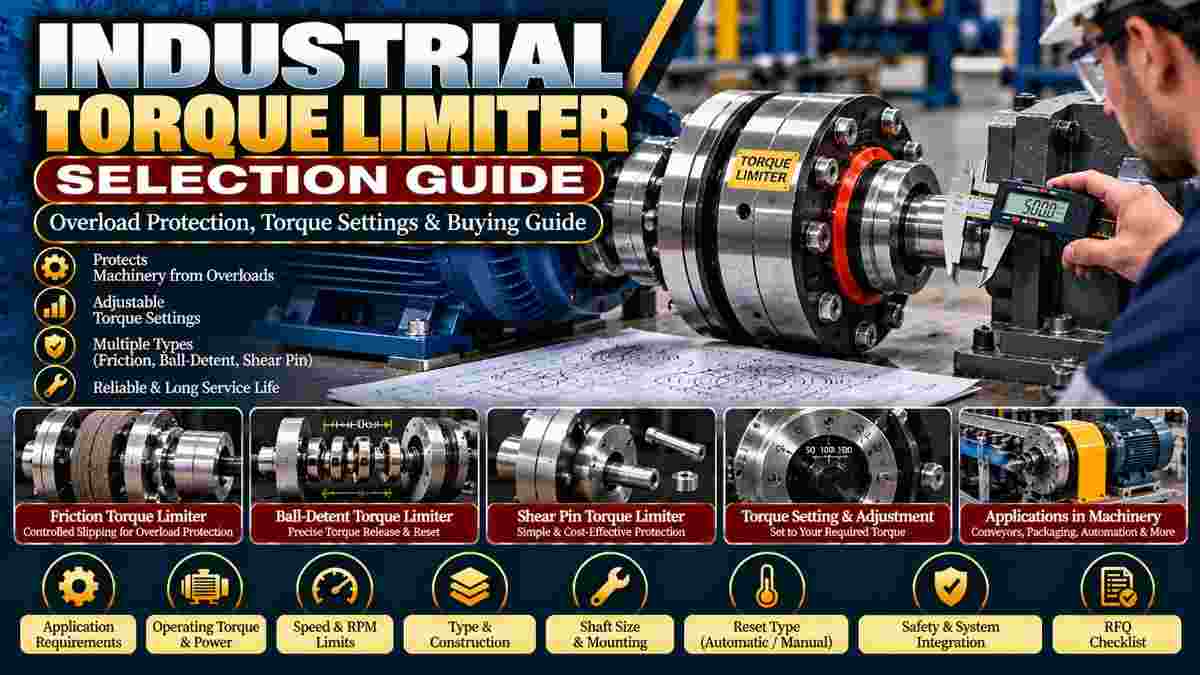
Common types include friction torque limiters, ball-detent torque limiters, and shear-pin arrangements.
How Does a Friction Torque Limiter Work?
A friction torque limiter allows controlled slipping when transmitted torque exceeds its frictional capacity.
It may suit applications where temporary slipping is acceptable.
However, continued slipping generates heat and can accelerate wear.
How Does a Ball-Detent Torque Limiter Work?
A ball-detent torque limiter uses spring-loaded elements that disengage when torque reaches a specified release setting.
Depending on the model, the device may re-engage automatically or require manual resetting.
How Does a Shear-Pin Torque Limiter Work?
A shear-pin arrangement protects machinery by allowing a designated pin to break when excessive torque is applied.
The pin generally requires replacement before operation resumes.
How Do You Calculate Normal Operating Torque?
Operating torque can be estimated from motor power and rotational speed when the transmitted power and speed are known.
For metric units:
Torque (Nm) = 9550 × Power (kW) ÷ Speed (RPM)
This calculation estimates steady-state torque.
Starting loads, acceleration, shock loads, and drivetrain efficiency must also be considered.
How Do You Select the Correct Torque Release Setting?
The release setting should exceed normal operating and expected acceleration torque but remain below the torque that could damage protected components.
Consider:
-
Normal operating torque.
-
Maximum acceleration torque.
-
Expected load variation.
-
Mechanical shock.
-
Weakest protected component.
-
Manufacturer adjustment range.
Avoid selecting a setting based solely on motor nameplate power.
Why Is Rotational Speed Important?
Rotational speed influences the suitability of the torque limiter, particularly during overload release and disengagement.
Higher-speed applications may require careful evaluation of:
-
Maximum permitted RPM.
-
Dynamic balance.
-
Residual torque.
-
Re-engagement behavior.
-
Rotating inertia.
-
Shutdown response.
Use the selected model's approved speed limits.
What Is the Difference Between Automatic and Manual Reset?
Automatic-reset designs can re-engage under specified conditions, while manual-reset designs require an operator-controlled procedure after disengagement.
Automatic re-engagement may be appropriate for certain repetitive machinery applications.
Manual-reset arrangements can be preferable when inspection or deliberate restart is required.
Re-engagement must follow manufacturer instructions and safe operating procedures.
Can Torque Limiters Prevent All Machinery Damage?
No. A torque limiter can reduce certain torque-related risks but cannot prevent every mechanical or electrical failure.
Additional safeguards may include:
-
Emergency stop systems.
-
Motor overload protection.
-
Machine guarding.
-
Speed monitoring.
-
Safety interlocks.
Torque limiters should be incorporated into the complete machinery protection design.
Which Applications Commonly Require Torque Limiters?
Torque limiters are useful where unexpected jams or excessive mechanical resistance could overload drivetrain components.
Examples include packaging conveyors, indexing machines, industrial automation equipment, and material-handling drives.
The protective device must be evaluated against the application's actual torque and movement requirements.
What Should You Check Before Replacing a Torque Limiter?
Replacement selection requires confirming the original model, release torque, shaft dimensions, mounting arrangement, and operating conditions.
Check:
-
Existing model number.
-
Rated and release torque.
-
Maximum RPM.
-
Shaft diameters.
-
Bore and keyway dimensions.
-
Coupling configuration.
-
Reset mechanism.
-
Available installation space.
Provide the existing component drawing whenever possible.
What Factors Affect Industrial Torque Limiter Prices?
Prices depend on torque capacity, protection mechanism, dimensional requirements, materials, precision, and customization.
Other cost factors may include overload detection sensors, special mounting connections, and inspection requirements.
Compare quotations using equivalent technical specifications.
What Should You Include in a Torque Limiter RFQ?
A complete RFQ should identify the machinery application, operating torque, overload threshold, speed, shaft dimensions, and reset requirements.
Provide:
-
Machine application.
-
Motor power and RPM.
-
Normal operating torque.
-
Peak acceleration torque.
-
Required release torque.
-
Preferred protection mechanism.
-
Maximum rotational speed.
-
Shaft and bore dimensions.
-
Mounting and keyway specifications.
-
Reset requirements.
-
Operating environment.
-
Quantity and delivery location.
These details help suppliers evaluate a suitable configuration.
Why Should Buyers Consider JobWurx Industrial Ventures?
JobWurx Industrial Ventures supplies industrial power transmission products for machinery manufacturers and maintenance teams.
Its product range includes couplings, industrial gears, chains, pulleys, and other transmission components.
Explore Torque Limiters for product information.
Confirm available models, release torque ranges, dimensions, and manufacturer documentation before ordering.
What Are the Most Frequently Asked Questions About Torque Limiters?
Common questions concern overload protection, torque settings, reset mechanisms, and replacement compatibility.
What Is the Difference Between a Torque Limiter and a Standard Coupling?
A standard coupling primarily transmits torque, while a torque limiter provides a defined overload response.
Can a Torque Limiter Be Adjusted?
Some models provide adjustable torque settings within manufacturer-defined limits.
Does a Torque Limiter Stop the Motor Automatically?
Not necessarily. Some devices require an integrated sensor or control-system connection to trigger shutdown.
Are Torque Limiters Suitable for Conveyor Systems?
Yes, when the device is correctly selected for conveyor loads, speed, startup conditions, and protection requirements.
Can Torque Limiters Be Customized?
Custom dimensions and configurations may be available depending on supplier and manufacturer capabilities.
How Can You Request an Industrial Torque Limiter From JobWurx?
You can request a quotation by sharing your application, motor specifications, operating torque, required release setting, shaft dimensions, and quantity.
For replacement applications, include the original device model or technical drawing.
Explore Torque Limiters or contact JobWurx Industrial Ventures to discuss your requirements.
Technical Note: Final torque limiter selection must follow manufacturer ratings, verified operating loads, machine risk assessments, and approved safety requirements.