How Do Gear Tooth Finish, Heat Treatment, and Alloy Grade Affect Industrial Gear Life?
- By: Expert Team
- November 8, 2026
Industrial gears carry continuous rotational loads across gearboxes, conveyors, cement and steel plants, mining machinery, and automated production lines. Even when two gears share the same module and tooth count, differences in base steel chemistry, surface hardening depth, and final tooth finishing dramatically change their resistance to pitting, scuffing, bending fatigue, and operating noise.
Understanding how metallurgy, heat treatment, and tooth geometry work together helps OEM engineers and maintenance teams specify gears built for real plant loads rather than premature replacement.
How Do Alloy Steels Like EN19, EN24, EN353, and 20MnCr5 Compare for Industrial Gears?
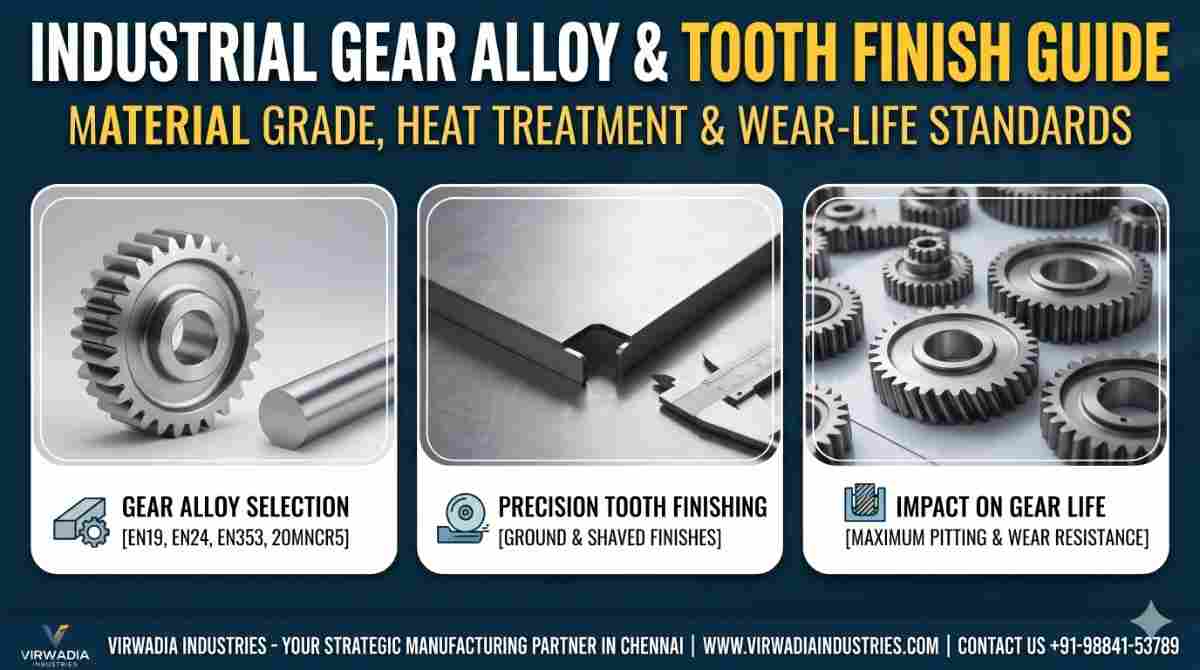
Alloy steels like EN19, EN24, EN353, and 20MnCr5 are compared by balancing core toughness against surface hardenability: medium-carbon alloy steels (EN19, EN24) deliver high tensile core strength for induction or through-hardened heavy drives, while low-carbon case-hardening steels (EN353, 20MnCr5) develop a wear-resistant hardened shell over a shock-absorbing ductile core.
-
EN19 & EN24 (Medium-Carbon Alloy Steels): Provide high tensile strength and torsional toughness, making them well-suited for heavily loaded shafts, pinions, and through- or induction-hardened spur and helical gears.
-
EN353 & 20MnCr5 (Case-Hardening Alloy Steels): Engineered for carburizing, creating a hard, wear-resistant outer tooth surface while keeping the inner core tough enough to absorb sudden shock loads without brittle fracture.
-
Carbon Steel, Stainless Steel & Phosphor Bronze: Standard carbon steels (such as EN8) serve moderate-duty drives, stainless steel protects gears in corrosive or washdown environments, and phosphor bronze is paired with hardened steel worms in worm wheel assemblies to minimize sliding friction.
Why Do Case Hardening, Carburizing, and Ground or Shaved Tooth Finishes Extend Gear Life?
Case hardening, carburizing, and ground or shaved tooth finishes extend gear life by increasing surface hardness to resist contact pitting and abrasive wear while removing heat-treatment distortion—ensuring uniform load distribution across the tooth flank, quieter meshing, and lower vibration on adjacent shafts and bearings.
-
Case Hardening & Carburizing: Enriches the outer surface layer with carbon before quenching, producing a hard outer case that resists surface fatigue and micropitting under high Hertzian contact stresses.
-
Tooth Grinding & Shaving: Precision post-heat-treatment grinding or pre-hardening shaving corrects micro-distortions in involute profile and lead, preventing edge loading and reducing gear whine at higher pitch-line velocities.
-
Protective Surface Finishes: Phosphate coatings, black oxide, and industrial rust-preventive finishes protect machined tooth flanks during storage, export transit, and initial break-in lubrication.
How Do Module, Pressure Angle, Face Width, and Gear Geometry Match Real Operating Loads?
Module, pressure angle, face width, and gear type match real operating loads by distributing transmitted torque across sufficient tooth root thickness and contact area—preventing tooth bending breakage and excessive surface stress across spur, helical, bevel, worm, ring, and rack-and-pinion configurations.
-
Module & Tooth Root Strength: A larger module increases tooth thickness and bending load capacity for slow, high-torque reducers, whereas finer modules deliver smoother motion in compact or higher-speed drives.
-
Face Width & Helical Overlap: Increasing face width expands the contact line carrying torque, while helical gears engage teeth gradually for quieter, higher-capacity transmission than straight-cut spur gears.
-
Right-Angle & Linear Profiles: Bevel and spiral bevel gears transfer power between intersecting shafts, worm and worm wheels achieve high single-stage reduction ratios, and rack-and-pinion sets convert rotary drive into controlled linear motion.
What Specifications Help Ensure Smooth Replacement or OEM Gear Integration?
Providing complete dimensional and metallurgical details—including gear type, module, number of teeth, helix angle and hand, pressure angle, face width, bore and keyway or spline tolerances, material grade, target hardness, and tooth finish—ensures smooth meshing and drop-in compatibility for OEM builds and MRO replacements.
-
Drawings or Physical Samples: Sharing 2D/3D CAD drawings or an existing sample allows engineers to verify center distance, pitch diameter, and backlash tolerances before machining.
-
Shaft Mounting & Alignment Details: Confirming bore fit, keyway dimensions, hub projections, and mating gear conditions prevents uneven tooth wear caused by shaft misalignment.
-
Batch Traceability & Export Readiness: Verified hardness checks, dimensional inspection reports, and corrosion-protected packaging ensure consistent batch performance for both domestic plants and international shipments.
How Can Jobwurx Support Your Custom and Replacement Industrial Gear Requirements?
Jobwurx Industrial Ventures Pvt. Ltd. manufactures and supplies precision Industrial Gears—including spur, helical, bevel, spiral bevel, worm and worm wheel, ring, girth, gear shaft, and rack-and-pinion gears—engineered to integrate smoothly with Industrial Couplings, bushes, and pulleys from our Mumbai hub for Pan-India and global export clients.
Whether you need custom OEM gear manufacturing in EN19, EN24, EN353, 20MnCr5, carbon steel, stainless steel, or phosphor bronze, or urgent replacement gears made to drawing or sample, our technical team is ready to assist. Explore more drivetrain engineering guides on our Blog, check common specifications in our FAQs, or Contact Us at +91 93214 95449 to request a technical quote today.