The Ultimate Guide to Roller Chain Maintenance: Measuring Elongation and Wear Life
- By: Expert Team
- February 17, 2026
Imagine pedaling a bicycle up a steep hill. You push hard on the pedals, the chain tightens, and the wheels turn to propel you forward. Now imagine that same concept scaled up to a massive industrial level. That is the sheer power of a roller chain. From heavy manufacturing plants and agricultural machinery to massive mining conveyors, these chains are the unsung heroes of mechanical power transmission.
They work relentlessly behind the scenes to keep our modern world moving. But just like a standard bicycle chain, industrial chains do not last forever. They require constant care, precise measurement, and proper lubrication to function at their best. Without routine maintenance, a small mechanical issue can quickly snowball into a catastrophic equipment failure, leading to expensive downtime and safety hazards.
In this comprehensive guide, we will explore everything you need to know about keeping your equipment running smoothly. We will cover the mechanics of chain wear, the exact limits of elongation, the best lubrication practices, and the ultimate strategies for maximizing the lifespan of your heavy machinery.
What Exactly is a Roller Chain and How Does It Work?
Before we dive into maintenance, it is crucial to understand what we are dealing with. A roller chain is a highly efficient mechanical device used to transmit mechanical power between two rotating shafts.
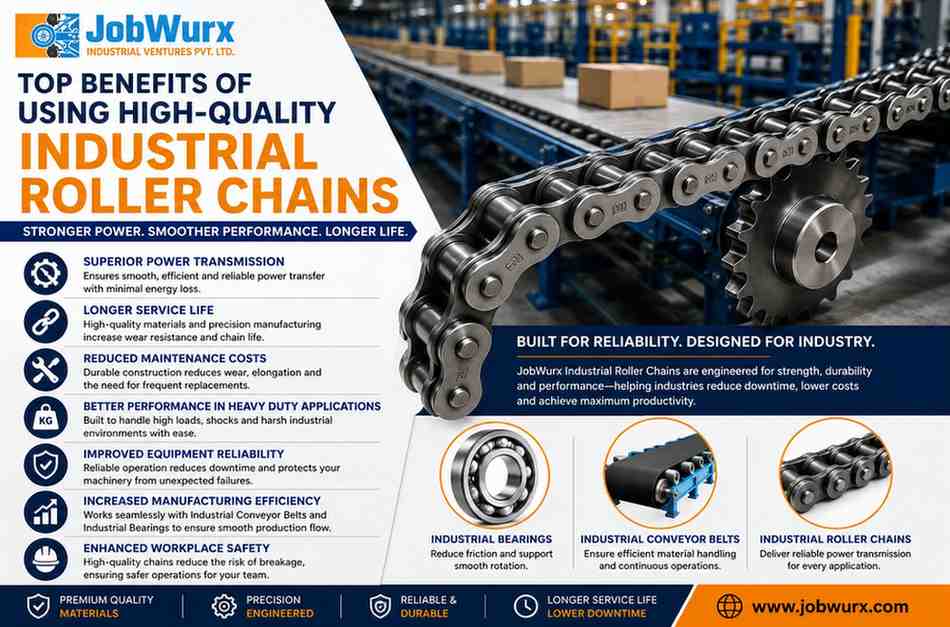
If you look closely at a chain, you will see it is not just a single piece of metal. It is a complex assembly of alternating inner and outer links. The inner links consist of two side plates held together by two cylindrical bushings. The outer links have side plates held together by solid metal pins that pass perfectly through the bushings of the inner links. Finally, a free-spinning metal roller sits on the outside of each bushing.
When the chain wraps around a toothed wheel called a sprocket, the gear teeth lock perfectly into the spaces between the rollers. As the driving motor turns the first sprocket, it pulls the chain, which in turn rotates the second sprocket to power the machine. It is a simple, elegant, and incredibly strong system. However, the continuous movement under heavy loads creates immense internal friction.
What Are the Primary Industrial Chain Wear Factors?
A common misconception in the manufacturing world is that chains "stretch" like a rubber band over time. Many people believe the steel side plates actually elongate under the pulling force of the motor. In reality, this is entirely false. The steel plates do not stretch. The phenomenon we call "chain stretch" is actually just mechanical wear.
As the chain bends around the sprockets, the metal pins rotate slightly inside the metal bushings. Even with a smooth surface, this microscopic movement creates friction. Over thousands of hours of operation, this friction slowly shaves away tiny layers of metal from the outside of the pin and the inside of the bushing. As the metal wears away, the gap between the pin and the bushing gets larger.
When you multiply this tiny increase in distance across hundreds of chain links, the entire chain becomes physically longer. This is the true cause of elongation.
Several key industrial chain wear factors directly accelerate this destructive process:
- Lack of Internal Lubrication: If oil cannot reach the hidden space between the pin and the bushing, metal grinds against metal. This is the fastest way to destroy a chain.
- Abrasive Environments: If your factory has high levels of dust, dirt, sand, or sawdust, these particles will stick to the chain. They act exactly like a gritty grinding paste, rapidly chewing through the steel components.
- Heavy Shock Loads: Sudden, violent starts and stops put extreme pressure on the pins and bushings, causing them to wear down much faster than a machine running at a smooth, continuous speed.
- Misaligned Sprockets: If the two sprockets are not perfectly in line with each other, the chain is forced to twist as it travels. This places severe uneven pressure on one side of the chain plates and rapidly accelerates wear.
Is Your System Reaching the Roller Chain Elongation Limit?
You might be wondering why a slightly longer chain is such a big deal. The problem lies in how the chain interacts with the sprockets.
Sprocket teeth are precisely machined to fit the exact spacing (known as the pitch) of a brand new chain. When a chain elongates due to wear, the distance between the rollers changes. The chain no longer drops smoothly into the bottom of the sprocket teeth. Instead, it starts to ride higher and higher up the face of the teeth.
This causes severe damage to the sprocket itself. If left unchecked, the worn chain will eventually skip over the teeth entirely, completely snapping the chain or destroying the surrounding machinery. To prevent this, engineers establish a strict roller chain elongation limit.
For most standard industrial applications, a chain is considered completely worn out and must be replaced when it has elongated by exactly 1.5 to 2 percent of its original length. If you are dealing with very precise machinery, fixed center drives, or massive sprockets with over 60 teeth, that tolerance limit drops significantly to just 1 percent. Pushing your equipment past this limit is a guaranteed recipe for a costly mechanical disaster.
Do You Know How to Measure Roller Chain Stretch Accurately?
Knowing the elongation limit is only half the battle. Finding out if you have actually reached that limit requires precise and careful measurement. You cannot simply push on the side of a chain to see if it feels slack. You need hard data.
Here is a simple, step-by-step guide on how to measure roller chain stretch with total accuracy:
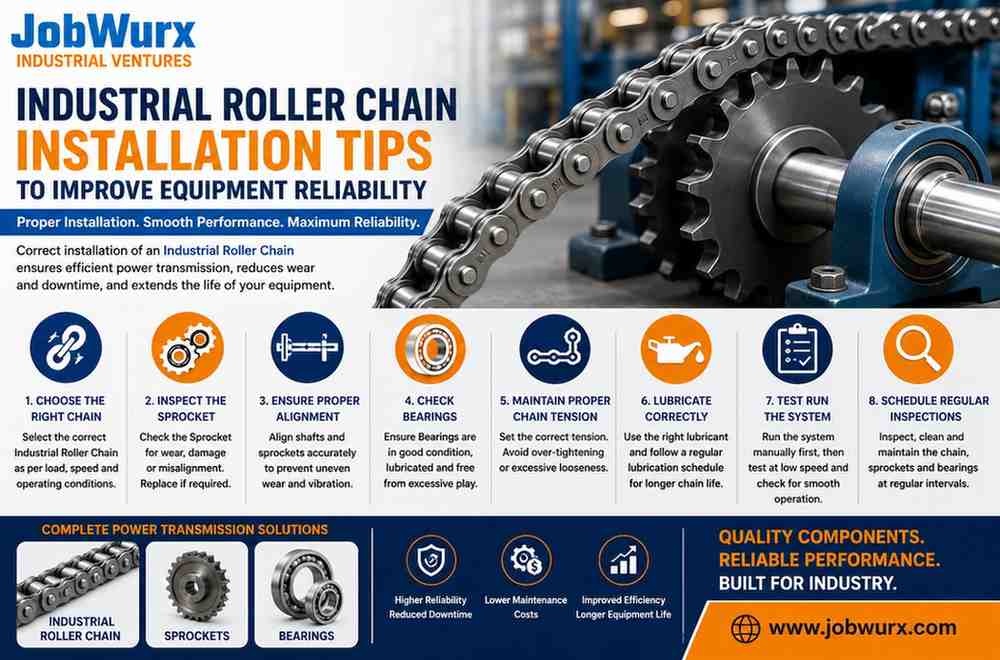
- Prioritize Safety First: Never attempt to measure a chain while the machine is running or energized. Completely power down the equipment and apply strict lockout and tagout procedures.
- Apply Working Tension: You cannot accurately measure a chain that is hanging loose. You must apply tension to pull the chain tight. This forces all the internal gaps and clearances to one side, giving you the true maximum length. You can do this by manually turning the drive shaft slightly against the resistance of the machine.
- Select the Right Tool: While a standard tape measure can work for a rough estimate, you should use a high-quality set of vernier calipers or a dedicated chain wear gauge for precise results.
- Measure Across Multiple Pitches: Do not just measure one single link. You need to measure a significant span of the chain to get an accurate average of the wear. A standard rule of thumb is to measure across a span of at least 10 to 12 pitches, or roughly 12 to 24 inches of chain length.
- Pin Center to Pin Center: Place the tips of your calipers exactly in the center of the first pin, and extend them to the center of the final pin in your measuring span.
- Calculate the Percentage: Compare your physical measurement to the mathematical factory length. For example, if you are measuring a 10-inch span of a brand new chain, a 2 percent stretch means the worn chain will now measure exactly 10.2 inches. If your measurement meets or exceeds that number, it is time to order a replacement immediately.
What Are the Most Effective Roller Chain Lubrication Methods?
The absolute best way to fight wear and elongation is through proper, consistent lubrication. Oil creates a microscopic protective film that prevents the steel pins from physically touching the steel bushings. However, pouring heavy grease over the outside of the chain is highly ineffective. The oil must be thin enough to penetrate the tiny gaps and get inside the internal joints. Choosing the right application technique is critical. Let us review the most common roller chain lubrication methods:
Manual Lubrication
This is the most basic approach. A maintenance technician uses an oil can or a stiff brush to manually apply lubricant to the inside loop of the chain. While this method is inexpensive, it is highly prone to human error. It is only recommended for very slow-moving chains operating in clean environments, and it requires a strict, disciplined schedule to be effective.
Drip Lubrication
This method removes some of the human error. A small oil reservoir is mounted above the chain drive. Tiny tubes are positioned directly over the chain edges, dripping a specific amount of oil continuously. This is an excellent solution for medium-speed applications. The key to success here is ensuring the drops fall exactly over the gap between the inner and outer link plates so the oil can seep inward.
Bath and Disk Lubrication
For faster-moving chains, gravity drips are not enough. In a bath system, the lowest section of the chain dips directly into a shallow pool of oil housed inside a sealed casing. In a disk system, a separate rotating wheel dips into the oil pool and physically slings the lubricant against the chain as it passes by. Both methods provide excellent, continuous coverage.
Force-Feed Lubrication
This is the gold standard for the most demanding, high-speed industrial environments. A mechanical pump forces a continuous, pressurized stream of oil directly onto the inside of the chain loop just before it engages with the sprocket. This advanced method not only provides perfect lubrication but also acts as a cooling system to reduce heat and a cleaning system to wash away abrasive debris.
How Should You Approach Heavy-Duty Roller Chain Maintenance?
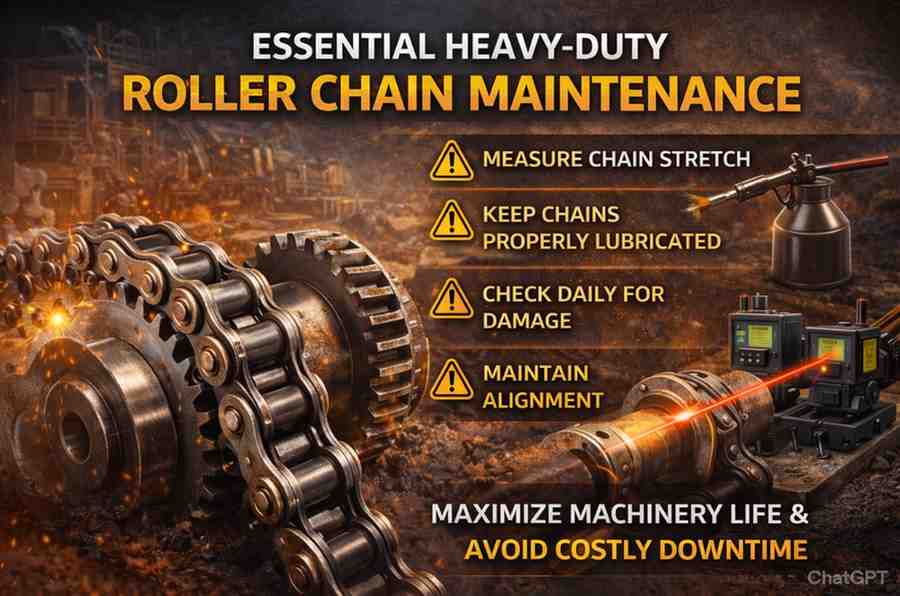
When dealing with massive equipment like mining excavators, forestry machines, or cement plant conveyors, standard maintenance rules are frequently pushed to their absolute limits. Heavy-duty roller chain maintenance requires a much more aggressive and proactive approach.
These massive chains face extreme shock loads, tons of abrasive dirt, and punishing outdoor weather conditions. To keep these vital heavy-duty systems running, your maintenance team must level up their strategy:
- Daily Visual Inspections: Heavy-duty environments cause rapid failure. Technicians must visually inspect the chains every single day. They need to look for cracked side plates, missing cotter pins, or rollers that refuse to spin.
- Aggressive Cleaning Protocols: In dirty environments like rock quarries, pouring fresh oil over a chain caked in mud creates a highly abrasive grinding paste. Heavy-duty chains must be routinely pressure washed or scrubbed clean before new lubricant is applied.
- Constant Alignment Checks: The massive torque generated by heavy-duty machinery can literally bend structural steel. You must frequently check the sprockets with a laser alignment tool. Even a minor structural shift will push heavy sprockets out of alignment and destroy the chain in a matter of days.
- Specialized Lubricants: Standard motor oil will completely fail under extreme pressure. Heavy-duty applications require specialized, high-viscosity industrial lubricants packed with anti-wear additives. These lubricants are specifically chemically engineered to stick to the metal and resist being squeezed out under massive loads.
Are You Ready to Maximize Your Chain's Lifespan?
A roller chain is a vital mechanical investment that drives the heart of your production line. When you treat it purely as an afterthought, you are opening the door to massive hidden costs, premature equipment failure, and frustrating production downtime.
By understanding the physics behind wear factors, strictly monitoring your elongation limit, mastering the exact measurement process, and implementing the perfect lubrication system, you can completely transform your maintenance program. Stop waiting for your equipment to snap. Take a proactive approach to your mechanical health today, and you will ensure your machinery runs smoother, quieter, and significantly longer.