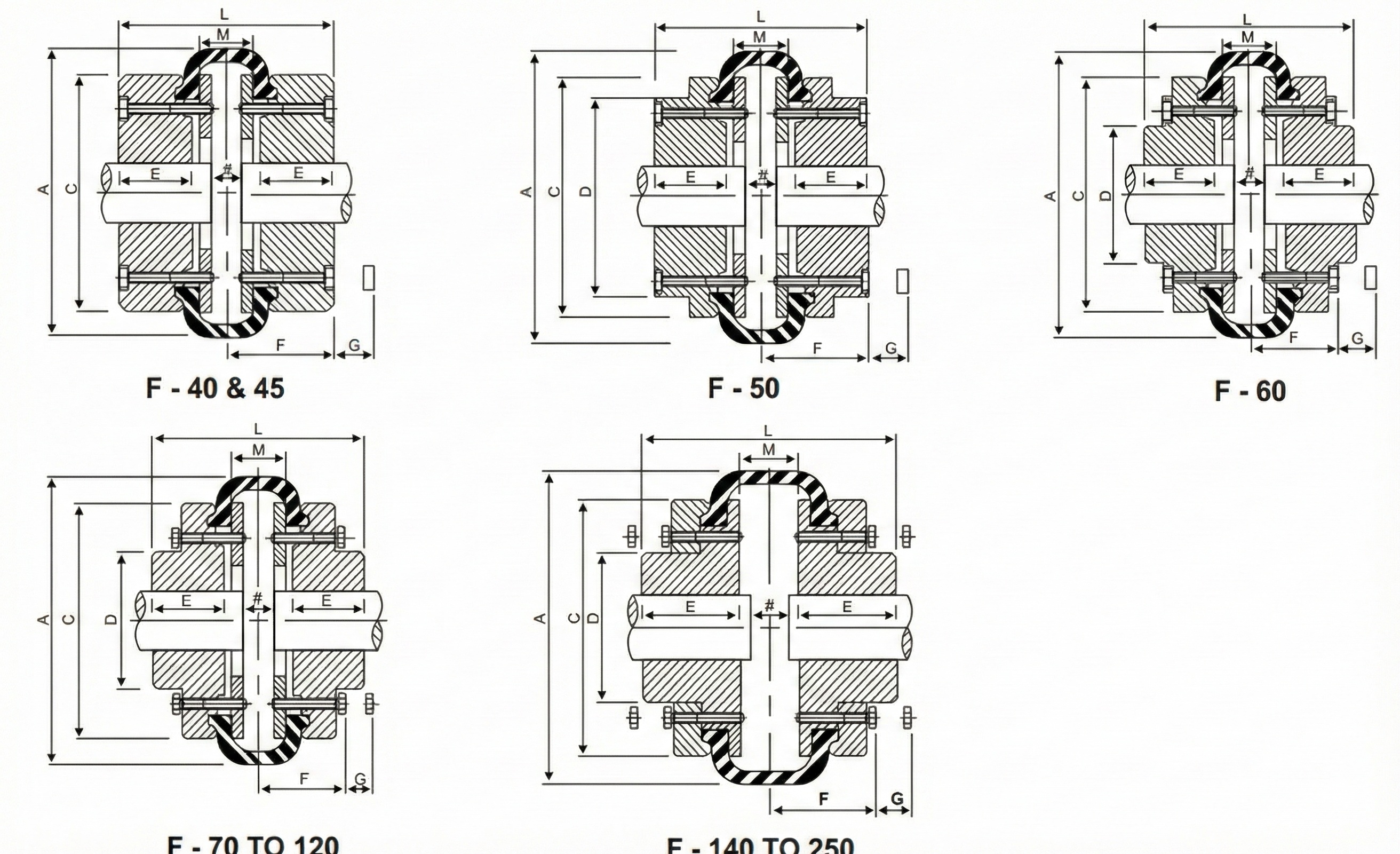
| Size | TYPE F & H | TYPE B | A | C | ‡ G |
† M |
No. of screws per flange |
||||||||||||||
|---|---|---|---|---|---|---|---|---|---|---|---|---|---|---|---|---|---|---|---|---|---|
| Bush No. |
Max Bore |
L | D | E | F | ξ J |
Approx Weight Kg * |
Max Bore |
Min Bore |
L | D | E | F | Set Screw on key |
Approx Weight Kg * |
||||||
| F40 | 1008 | 25 | 67 | - | 22 | 33.5 | 29 | 1.4 | 30 | 11.00 | 67 | - | 22 | 33.5 | M5 | 2.0 | 104.0 | 82 | 43 | 23 | 4 |
An F40 tyre coupling is a flexible elastomeric coupling used in industrial power transmission systems to join two rotating shafts while compensating for misalignment and absorbing shocks and vibration. It consists of two flanges and a rubber tyre element, providing smooth torque transfer and long service life.
Typical specifications for an F40 tyre coupling include:
Size: F40
Bore diameter: Up to ~25–30 mm (varies by design)
Max rotational speed: ~4500 rpm
Nominal torque: ~24–25 Nm
Material: Durable elastomer rubber tyre with steel or cast flanges
Misalignment handling:
Parallel: ~1.1 mm
Angular: ~4°
Axial end float: ~1.3 mm
Lubrication: Lubrication-free design for minimal maintenance
Popular product variants include spares and tyre elements such as SKF Tyre Coupling Element F40 NR, Fenner Fenaflex Tyre Coupling with B Flange F40, and Fenner F40 Fenaflex Tyre Coupling Spare.
The F40 tyre coupling uses a flexible rubber “tyre” insert mounted between two rigid flanges. When the driving shaft rotates, torque transmits through the flanges and tyre element. The elastomer tyre:
Absorbs shock loads
Reduces torsional vibration
Compensates for angular, parallel & axial misalignment without stressing bearings or gears
Because the tyre is elastomeric, it deforms under load to cushion dynamic loads and deliver smoother operation.
Using an F40 tyre coupling delivers several advantages:
Handles angular, parallel and axial misalignment simultaneously, reducing the need for ultra-precise alignment.
The rubber tyre element dampens vibration and shock, protecting connected equipment like motors and pumps.
No lubrication required and minimal wear on moving parts, leading to lower maintenance costs.
Quick assembly or tyre replacement without disturbing the machinery setup.
Reduced operational stress on bearings and shafts extends machine life.
The F40 tyre coupling is widely used across industrial sectors such as:
Pumps and compressors
Conveyors and material handling
Fans and blowers
Mixers and agitators
General industrial drives where vibration damping and misalignment compensation are required
Its compact design suits both light-duty and medium-duty machinery.
Select the coupling size based on motor power, service factor, and operating speed — ensure the F40 size can handle required torque and rpm.
Choose the correct bore size and flange style (F, H, or B) to match shaft diameters and installation method.
Check manufacturer-specified limits for angular, parallel and axial misalignment — stay within tolerance for optimal life.
Consider elastomer type (e.g., FRAS for fire-resistant/anti-static, natural rubber for standard use) based on operating conditions.
Although low maintenance, periodic inspection of tyre wear and fastener tightness is recommended for reliability.
The F40 tyre coupling is a flexible, elastomeric shaft coupling ideal for industrial torque transmission where vibration damping and misalignment compensation are critical. Its maintenance-free operation, ease of installation, and ability to protect connected machinery make it a cost-effective choice for a broad range of applications — from pumps and compressors to conveyors and general drive systems. With proper sizing and installation, F40 tyre couplings offer smooth performance, reduced downtime, and extended equipment life.